

At a time of growing geopolitical instability, and as the United States conducts major military operations in the Middle East and faces fragile global supply chains, critical minerals have moved to the centre of national security planning. Yet in Central Africa, this strategy faces a growing tension.
In early February, Washington hosted the Critical Minerals Ministerial, bringing together 54 countries from Europe, Asia, Africa and Latin America. The Democratic Republic of the Congo was invited as a key partner. Rwanda was not.
At the summit, Vice President JD Vance warned that global mineral markets remain “brittle and exceptionally concentrated.”
The administration announced FORGE, a new allied coordination framework for critical mineral supply chains, and launched Project Vault, a $12 billion strategic reserve designed to protect the American economy from external shocks.
The objective is clear: reduce dependence on China and secure materials essential to America’s defence industrial base.
Yet developments in eastern Congo expose a structural contradiction between U.S. strategy and realities on the ground.
The Democratic Republic of the Congo produces around 70% of the world’s cobalt, making it the most important source of a mineral essential to batteries, advanced electronics and military technologies.
Eastern Congo is also a major source of the so-called 3T minerals — tantalum, tin and tungsten — that are critical to semiconductors, aerospace components and advanced weapons systems. A single F-35 fighter jet requires hundreds of kilograms of specialty minerals for avionics and targeting systems. Nearly four-fifths of the U.S. Department of Defense’s weapons systems — and more than 90% of U.S. Navy systems — depend on supply chains heavily influenced by China.
Washington’s response has focused on diversification. The Lobito Corridor, backed by the U.S. and the European Union, aims to transport Congolese minerals westward to the Atlantic, bypassing opaque eastern trade routes. Yet infrastructure alone cannot resolve deeper geopolitical dynamics.
Instability in eastern Congo has produced a structural alignment between China’s dominance in mineral refining and Rwanda’s role as a regional export hub for minerals flowing eastward.
A fragmented Congolese state, lacking full control over key mining zones, lets mineral access be shaped by armed actors and informal networks rather than transparent sovereign authority. Recent developments have made this contradiction increasingly visible.
In February, Congo added the Rubaya coltan mine in North Kivu to a shortlist of assets proposed for cooperation under a bilateral minerals framework with the United States.
Rubaya is one of the world’s most significant coltan deposits, accounting for roughly 15 to 20% of global production. The Democratic Republic of the Congo is believed to hold about 80% of global coltan reserves.
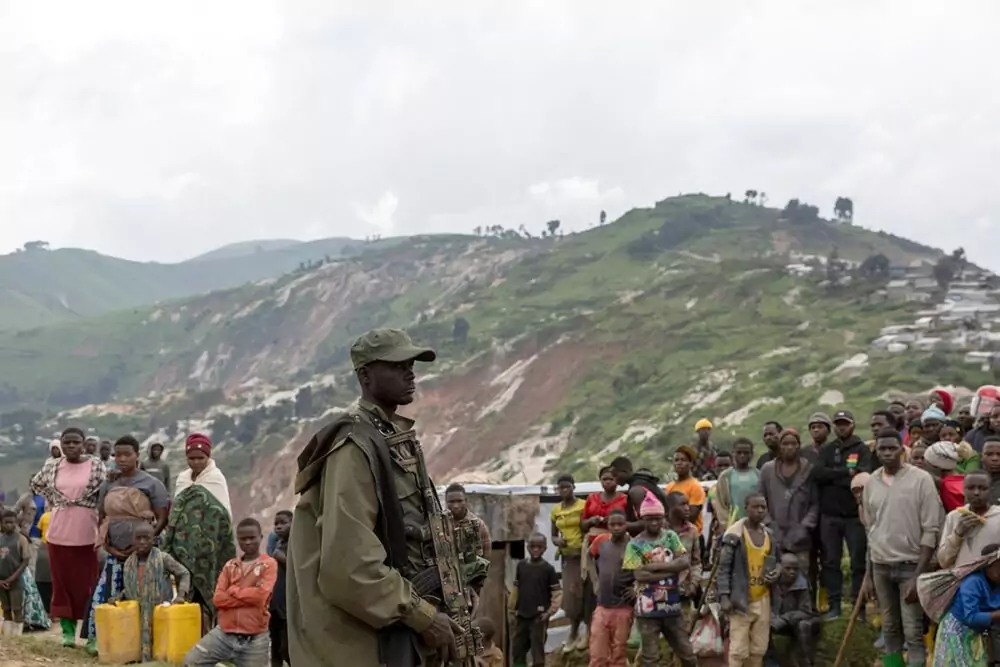
Yet Rubaya remains under the de facto control of a Rwanda-backed armed group operating in eastern Congo, known as the M23 rebellion.
Experts have documented how M23 taxes mining operations and supervises mineral flows across the border into Rwanda, where ore is mixed with domestic production before entering international supply chains — often destined for China-dominated refining industries.
The United Nations estimates that at least $800,000 per month is generated from taxation around the Rubaya mine alone. Trade data further show Rwanda’s tantalum exports surging in recent years, coinciding with the expansion of rebel-controlled territory.
Between 2021 and 2024, Rwanda-China trade more than doubled, while Rwanda’s exports to China increased more than fivefold.
The structure is increasingly clear: Minerals extracted in eastern Congo move eastward through Rwanda before entering refining networks largely dominated by China. Washington itself has begun acknowledging the strategic implications.
This month, the United States imposed official sanctions against Rwanda, signalling growing recognition that instability in eastern Congo intersects with global competition over critical mineral supply chains.
For years, Washington relied primarily on incentives — investment commitments, diplomatic engagement and targeted sanctions — to influence Rwanda President Paul Kagame’s behaviour.
The Washington agreements between Congo and Rwanda were framed as economic openings, suggesting that Rwanda could formalise and expand its role in processing eastern Congolese minerals through commercial channels rather than conflict.
Yet inducements without credible constraints have coincided with continued destabilisation.
Sanctions alone are unlikely to shift Rwanda’s calculations. For a regime that views eastern Congo as both strategic depth and economic leverage, financial penalties rarely outweigh perceived geopolitical stakes.
What has historically altered regional dynamics is a shift in the balance of power on the ground. Recent battlefield developments illustrate this point.
Private military contractors from U.S. and Israeli companies have supported Congolese operations in eastern Congo, including efforts that helped Kinshasa’s forces regain control of the strategic city of Uvira in South Kivu. The city had briefly fallen to Rwanda-backed M23 forces only days after the Washington peace agreements were signed. Their involvement reflects a growing recognition that mineral security and regional security are inseparable — and that supply-chain stability ultimately depends on who controls the territory where those minerals are extracted.
Mineral security cannot be separated from regional security realities. Supply-chain diversification and managed instability cannot coexist.
Eastern Congo is emerging as another arena of geopolitical competition between the United States and China, alongside theatres such as Venezuela or Iran. Washington’s decision to sanction Rwanda — a longstanding U.S. partner — suggests that policymakers increasingly recognise this reality.
But securing U.S. mineral supply chains will ultimately depend on stabilising eastern Congo, and on whether Washington is prepared to sustain and intensify pressure on Rwanda until the pathways that divert Congolese minerals into rival supply chains are finally closed.
Norman Ishimwe Sinamenye, president of Jambo ASBL, is a Rwandan-born political and geopolitical analyst focusing on Central Africa and the Great Lakes region. He has spent more than a decade engaged with issues of regional security, cross-border conflict, and the political economy of instability in eastern Democratic Republic of Congo and Rwanda.
Discover more from Mining News Group
Subscribe to get the latest posts sent to your email.