

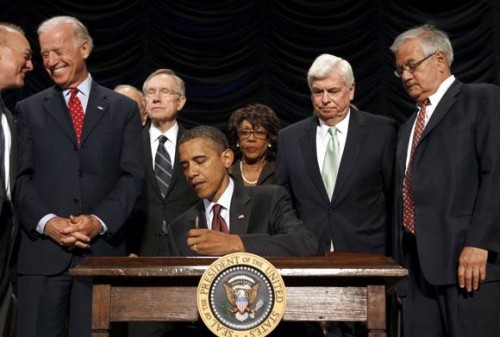
Chris Dodd and Barney Frank to the right of Barack Obama, on the day the Dodd-Frank Act was signed, July 21, 2010
The US authority in charge of regulating derivatives, the Commodity Futures Trading Commission (CFTC), approved a new proposal on November 5 to limit speculative trading in these products.
Passed by a vote of 3 to 1 by members of the U.S. commodities market regulator, this regulation proposes, among other things, to limit an investor’s transactions for contracts with a given expiry date to 25% of the supply that can be physically delivered at that date. This would allow at least 80 different traders to match their buy and sell orders. The goal is to prevent one or two traders from manipulating prices by holding or selling an excessive number of contracts.
The CFTC members, who met in Washington, include a total of 28 products,
including corn, soybeans, cocoa, sugar, oil, natural gas and metals.
” The Commission does not set prices or regulate them, it is there to promote the integrity of futures contracts ,” its chairman, Gary Gensler, reminded everyone.
“ Since the Commodity Exchange Act of 1936, limitations on various contracts have been a tool to contain or prevent excessive speculation ,” he emphasized. This new set of standards would, according to the CFTC, “ prevent market manipulation while ensuring sufficient liquidity for bona fide investors and protecting the pricing process .” The regulator specifies that “ approximately 400 brokers ” would be affected by these limitations.
Exemptions are indeed planned for brokers whose positions are deemed to be ” in good faith .” But for Zohar Hod of the risk analysis and management firm SuperDerivatives, ” the definition of ‘good faith’ is both vague and entirely subjective, and risks creating confusion in the market .”
This regulation is a second attempt to implement a provision of the 2010 Wall Street Reform Act (Dodd-Frank Act). The first attempt was rejected in September 2012 by a US judge acting on a petition from the International Swaps and Derivatives Association, which represents 800 major derivatives investors worldwide. The CFTC appealed this decision.
(With Ecofin Agency)
Discover more from Mining News Group
Subscribe to get the latest posts sent to your email.