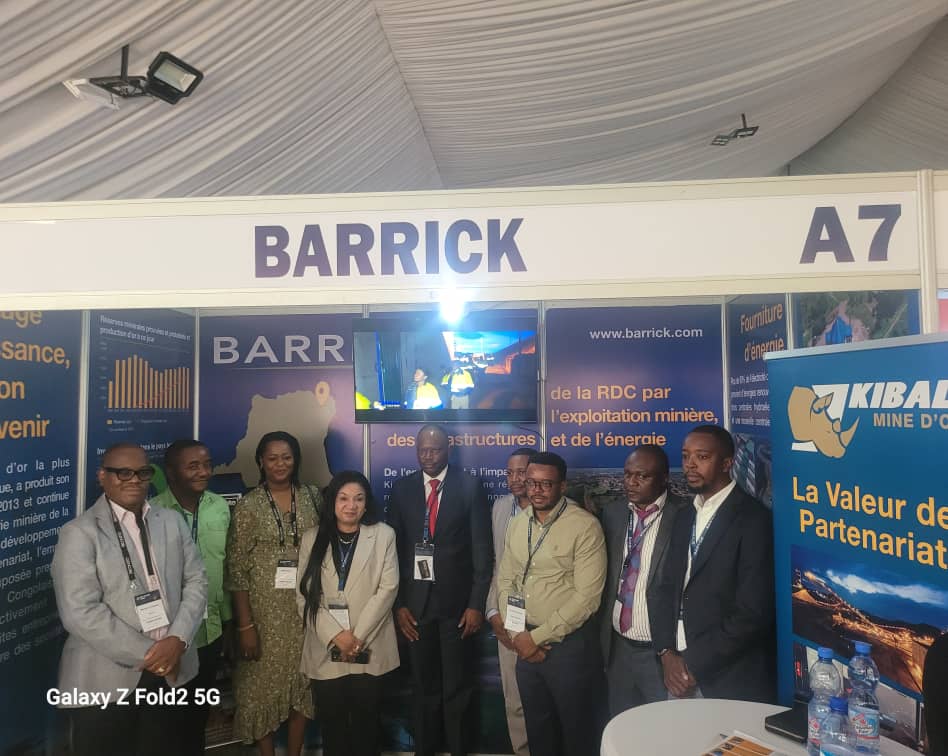
Press conference given by Director General Cyrille Mutombo during the celebration of the 20th anniversary of the mining week in Katanga held from June 11 to 14 at Pull Man Karavia.
1) Mr. Managing Director Cyrille Mutombo, the panel you participated in addressed the lack of reliable production and export data, which creates uncertainty for investors and buyers in the country. How does Kibali, as a responsible company, manage this issue?
CM: For our part, as Kibali or as Barrick, don’t forget that Kibali is only about gold, and I appreciate it when we’re not reduced to just gold. We should be given the benefits of what Barrick represents, which includes gold and also copper. The first thing is to declare what you pay, what you produce, to declare everything we do. That’s transparency, this exercise in accountability. That’s the exercise we’re undertaking. And we believe that when we do this, and if all the players do it, it’s already a foundation for further improvement. For the rest, we encourage government actors to work so that once this data is collected and presented, it can be easily understood by investors, who, incidentally, don’t like the unpredictable or who prefer to reduce the unpredictable nature of the sector and have a much more reliable, better-known, and more controlled environment.
2) Mr. Director General Cyrille, Kibali is mining copper here in Katanga, at this stage what can we conclude about this stage of copper production.
CM: Kibali doesn’t mine copper; Kibali is a gold mine, the largest gold mine, one of the top five in the world. It’s actually the parent company we belong to, the Barrick Group, that deals in gold and copper. In Upper Katanga, like any investor keen on investing, we went to the mining cadastre a little over two years ago to apply for exploration permits. We targeted areas where preliminary work had already been done, and these permits were granted. We followed the entire process, and since receiving these permits, we’ve been seeking to add more, and work is beginning.
We are not yet at the exploitation stage; we are in the research or exploration phase, which has just begun. And as you know, everything in this business, exploration in the mining sector, takes years, easily 5 to 10 years. This allows you to identify any anomalies once you have found them, then you conduct more advanced research to move on to more advanced drilling exercises, and once you have defined your resources and the subsequent modeling, your feasibility studies, and then you proceed with development. So we don’t know how long it will take us with regard to copper, but we keep doing it because we have the technical expertise. As the Barrick group, we’ve been operating near Zambia, and we have the Lumwana mine, which is a serious expansion project in which Barrick is investing an additional 3 billion. We believe that as our geologists progress with this research, we can one day be considered a key player in copper production in the DRC.
3) Barrick Gold, the operator of Kibali Goldmines, has decided to change its business name to Barrick Mining. What’s changing? Do you want to become a crowdfunding mining company?
CM: The change is simple. First, under the direction of the group’s board of directors, which gave all the necessary authorizations to our Chairman, the CEO, Mr. Mark Bristow, we initiated these steps. We are also in the process of relocating our headquarters, which will certainly be established in the United States in the coming months or years. But the name change was more about reflecting who we are. We are the Barrick Group, certainly, we were the Barrick Group. But we also have copper mines, as you know, copper mines in Latin America, and here in Africa, as I just mentioned, and even in the Middle East and the DRC, where we have begun copper exploration. So, being a group that deals with just these two things, copper and gold, keeping the name Barrick Gold is not true to who we are. That is why our authorities, including the CEO, decided to change the group’s name from Barrick Gold to Barrick Mining, to accurately reflect who we are and, above all, who we want to become as a key player aiming to play a significant role not only in the gold sector but also in the copper sector.
4) What do you gain from participating in this type of forum?
CM: We benefit from being present at this forum because it’s a platform for exchange where we share with other stakeholders. Here you have political decision-makers, operators like ourselves, as well as subcontractors and business developers. So, this is a very important forum for us to contribute to the development of thinking on mining activity in the DRC. We believe we have a role to play in this, not just to express our opinions, but also to listen to other stakeholders to see what’s being done and discover the new developments at each edition. And by the way, a tip of the hat to the organizers for these 20 years. Twenty years of consistent effort; we must continue to work as they have, it deserves encouragement.
5) Currently, there is a boom in the global gold market, with prices rising to the great satisfaction of producers. What are the factors behind this boom?
There are many factors, which certainly makes us happy, as you said. There are several factors, as we discussed earlier in this panel, namely geopolitical factors. Today, we have the trade war we are witnessing between the United States and China, who are clashing over a number of issues, including tariffs. This is one of the things that affects not only the price of gold but also the prices of other metals. Sometimes, currencies are also a factor, as most of these exchanges are centered on them, and discussions are going in all directions. Some economic blocs want to adopt their own currencies, which means that discussions continue. In a context like this, uncertainty arises, and when uncertainty arises, people seek a safe haven, generally gold. Gold is often considered a safe haven asset, leading to numerous gold purchases. You’ve seen the trend with many central banks building up gold reserves for their countries, and this is tending to spread to other countries. So this is the trend we are in, but we expect the illicit market will not continue like this; there will be times when it will fall, and the business is this ability to maintain its activity whether the price goes up or down, and this is precisely what allows us to remain consistent and keep our business going.
6) Kibali is exploring for copper and cobalt in Katanga, while the current market context has led the Congolese government to suspend copper exports. What is your personal interpretation?
CM: We’re getting into copper not because we want to start, but because Barrick is already doing it. We’re a company that deals with both copper and gold, so it’s only in the DRC, where we were previously involved in gold, that we’re now moving into the copper sector as well, because we have requests for several years and we’re continuing to submit those requests. So you were talking about the export suspension. I believe the Congolese government is taking steps to leverage and benefit. Metals should benefit the country, and the only way to do that is sometimes when prices rise. The lever the government is using is suspension for controlled exports. This is a policy to be encouraged, especially when it’s implemented in a coordinated manner so that the stakeholders understand when these suspensions are lifted or authorized. But since we are the leading producers, the government has the right to decide when to supply the market and when not to.
The government can use the simple law of supply and demand. When you ratify a product, you increase its value, and that’s the simplest economic principle. Let’s make cobalt scarce; as it becomes less available, demand will increase, pushing the price up and allowing us to release it onto the market. Now, the exercise of control must follow to maintain this balance. When we have restricted the flow, and when we open it, we mustn’t open it completely, allowing everything to flow out, so that the flow reverses the direction of the needle. We encourage the government to do this because it will put the DRC in a position of control and, above all, governance.
7) What is the situation in the country?
CM: We commend the government’s efforts, which are becoming increasingly visible with the DRC’s attainment of a non-permanent seat on the Security Council—truly a major achievement. We congratulate and encourage these efforts towards the pacification of the country. Furthermore, within the context of this geopolitical situation, the United States is showing interest in our DRC minerals, and we appreciate the efforts being made to foster dialogue. We discourage those who criticize the government for selling these resources; I don’t believe that’s the case. This is a win-win negotiation because we must not keep these minerals for ourselves and our children.
Thank you, DG
Discover more from Mining News Group
Subscribe to get the latest posts sent to your email.