

Kinshasa — February 2026
What if artisanal gold was no longer a story of smuggling, informality, and lost state revenue — but instead became the foundation of sovereign finance, macroeconomic stability, and national security?
That is the structural shift now underway in the Democratic Republic of the Congo.
Under the leadership of His Excellency Félix Tshisekedi, and with operational execution led by His Excellency Louis Watum Kabamba, Minister of Mines of the Democratic Republic of the Congo, the country has launched one of its most ambitious gold-sector governance reforms in decades.
This is not incremental policy reform. It is a sovereignty strategy.
Gold Elevated to a Matter of State
On 20 February 2026, at the Cité de l’Union Africaine in Kinshasa, His Excellency the President chaired the 79th Ordinary Meeting of the Council of Ministers.
Gold was not treated as a routine sectoral update.
It was framed as a matter of macroeconomic stability and national authority.
The President made it clear: gold constitutes a major strategic resource for public finances and macroeconomic equilibrium. Yet a significant share of national production continues to escape official circuits due to:
- The dominance of artisanal mining
- Porous borders
- Fiscal differentials with neighboring countries
- Informal commercialization networks
The consequences are structural:
- Substantial public revenue losses
- Underreported export volumes
- Fragile control over foreign exchange flows
- Risks of illicit financial circuits
The issue is not whether Congo produces gold.
The issue is whether the State governs its full value chain.
Immediate Directive: An Integrated Gold Flow Strategy
Recognizing the urgency, His Excellency instructed — under the coordination of the Prime Minister — a cross-ministerial framework including:
- The Vice Prime Minister of Interior and Security
- The Vice Prime Minister of National Economy
- The Minister of Finance
- The Minister of Foreign Trade
- And centrally, His Excellency Louis Watum Kabamba, Minister of Mines
to design and implement without delay an integrated and operational strategy for:
- Capturing gold flows
- Ensuring traceability
- Securing strategic exit points
- Preserving fiscal and financial interests
- Combating fraud and smuggling
This marks a transition from reactive enforcement to systemic restructuring.
The Four Pillars of the National Gold Strategy
The strategy to capture and secure gold flows rests on four structural pillars:
National Traceability & Centralisation
A national system based on:
- Identification of all actors in the gold chain
- Mandatory sales through licensed comptoirs
- Interconnection with mining administration systems
- Integration with the Banque Centrale du Congo
- Centralised payments through the official banking circuit
Traceability becomes monetary governance.
Economic Incentives to Outperform the Parallel Market
Rather than relying solely on repression, the strategy introduces:
- Targeted fiscal adjustments
- Price mechanisms indexed to international benchmarks
- Rapid and transparent payments to producers
The logic is simple but strategic:
If the informal market dominates, the official circuit must become more attractive. Sovereignty must compete — not just regulate.
Reinforced Border & Exit Controls
The government is strengthening:
- Targeted controls at strategic exit points
- Regular audits
- Enhanced supervision of exposed agents
- Cooperation with anti-illicit financial flow services
Because gold leakage is not only a mining issue. It is a financial stability issue.
Regional Cooperation
Recognizing that smuggling does not respect borders, the DRC is advancing:
- Customs information exchange
- Harmonisation of certification mechanisms
- Coordination to prevent regulatory arbitrage
Without regional alignment, domestic reform would simply shift flows elsewhere.
AXIS and SGRT: Reengineering Sovereign Capital
If the gold flow strategy is about governance control, then AXIS and the Sovereign Gold Reserve Token (SGRT) are about financial architecture.
Together, they represent an attempt to redesign how natural resources translate into sovereign capital.
AXIS formalises artisanal and semi-industrial production, secures certified reserves, and structures traceable supply chains under the authority of His Excellency Louis Watum Kabamba.
At the core of AXIS lies SGRT — an instrument designed to be:
- Backed by certified gold reserves
- Anchored in traceable production
- Structured within national legal frameworks
- Independent of sovereign debt accumulation
This is not borrowing against the future.
It is structuring capital around sovereign assets.
For decades, resource-rich nations have followed a familiar cycle: export raw materials, borrow externally, repay with interest.
SGRT challenges that model.
It proposes that verified mineral reserves — particularly from formalised artisanal production — can underpin structured financial instruments without:
- Transferring ownership
- Mortgaging concessions
- Increasing public debt
The implications are financial — and geopolitical.
The MoU: Institutional Anchoring, Not Symbolism
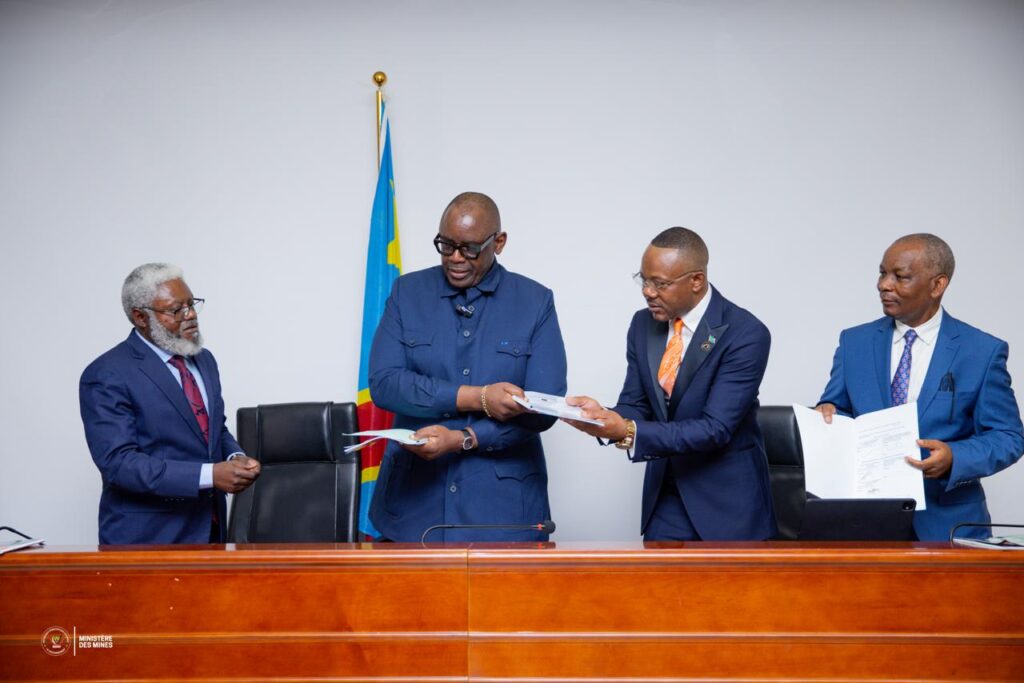
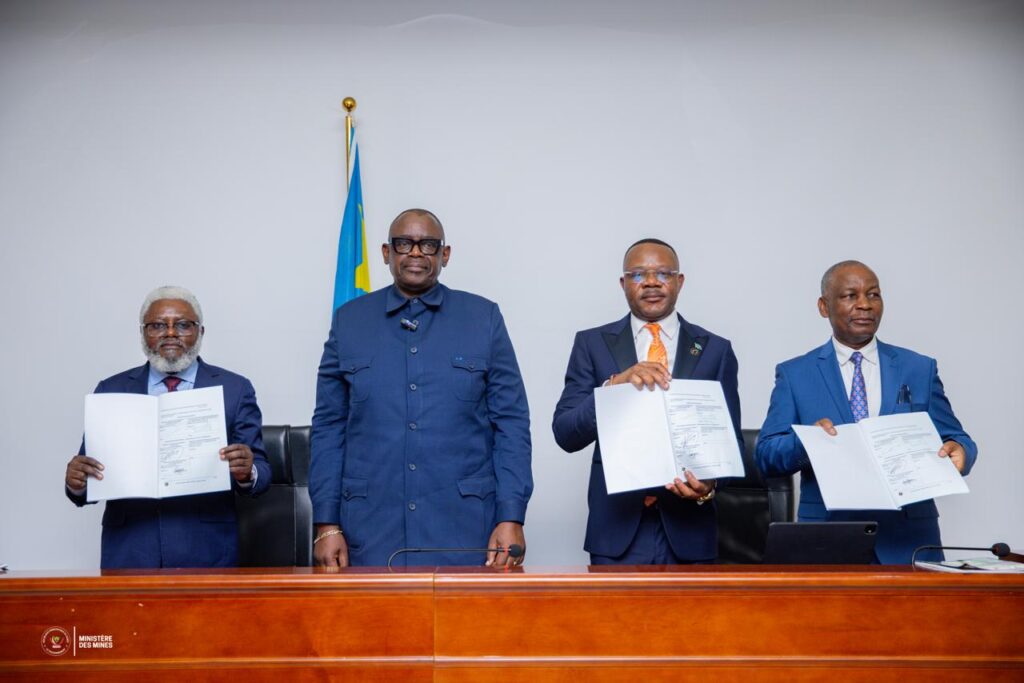
The Memorandum of Understanding signed during Mining Indaba 2026 — signed by His Excellency Louis Watum Kabamba in his capacity as Minister of Mines — provides the legal and operational framework underpinning AXIS and SGRT.
This was not a ceremonial signature. It establishes:
- Defined institutional roles
- Oversight mechanisms
- Alignment with national mining and financial legislation
Without institutional anchoring, innovation risks being dismissed as speculative. With state authority embedded, AXIS and SGRT become sovereign instruments.
Governance as the Deciding Factor
AXIS and the national gold flow strategy are interconnected. Traceability enables certified reserves.
Certified reserves enable structured backing.
Structured backing enables sovereign financial instruments. If one link weakens, the model weakens.
If governance holds, the architecture holds. This is not a technological experiment.
It is a governance test.
The Bigger Question
Can a resource-rich African state convert artisanal gold into:
- Sustainable fiscal revenue
- Stabilised foreign exchange inflows
- Asset-backed financial structuring
- Stronger territorial authority
- Reduced illicit leakage
— all without increasing sovereign debt?
The Democratic Republic of the Congo is attempting to answer that question in real time.
With His Excellency Félix Tshisekedi setting the political mandate, and His Excellency Louis Watum Kabamba operationalising the mining architecture, gold is no longer treated as a commodity alone.
It is being governed as a strategic instrument of state power.
If execution matches ambition, this will not simply reform a sector.
It could redefine how natural wealth translates into sovereign strength.
And that is why this moment matters — not just for Congo, but for every resource-rich nation watching closely.
Discover more from Mining News Group
Subscribe to get the latest posts sent to your email.