
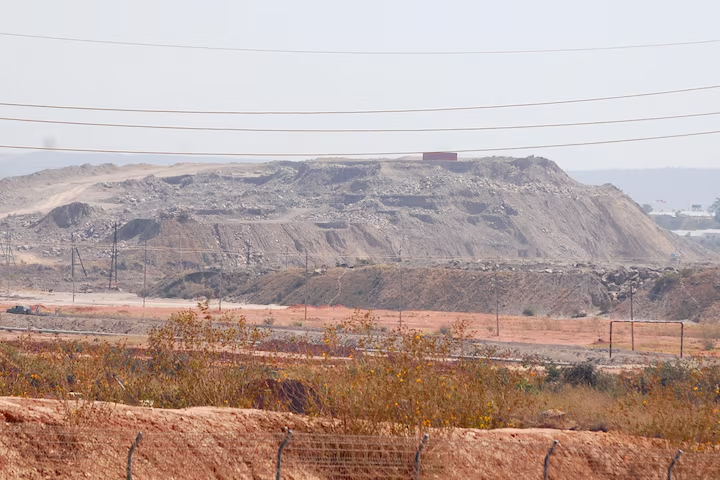
The Democratic Republic of Congo has launched a new technical and financial audit into one of the most controversial mining agreements in Africa, the Chinese-backed Sicomines minerals-for-infrastructure deal.
The review, announced on March 5 by the government’s Regulatory Agency for the Monitoring and Coordination of Collaboration Agreements (APCSC), will examine the mining operations, infrastructure spending and debt financing tied to the agreement since its inception in 2008.
For the global mining industry, the move signals renewed scrutiny over one of the largest resource-for-infrastructure agreements ever signed, and one that sits at the center of the global copper and cobalt supply chain.
A Landmark Deal That Reshaped Congo’s Mining Sector
The Sicomines agreement was originally signed in 2007–2008 between the Congolese government and a consortium of Chinese state-owned companies including Sinohydro and China Railway Engineering Corporation.
The structure was simple but unprecedented in scale.
Chinese companies would finance and build infrastructure across the country (including roads, hospitals and universities) while receiving mining rights to vast copper and cobalt deposits in the mineral-rich Katanga region.
At the time, the deal was valued at roughly $9 billion, with $6 billion earmarked for infrastructure and $3 billion for mine development, financed largely through Chinese policy bank loans.
In return, the joint venture Sicomines (Sino-Congolaise des Mines) obtained access to deposits containing an estimated 6.8 million tonnes of copper and more than 400,000 tonnes of cobalt near Kolwezi, one of the world’s most important battery-metal districts.
Chinese partners hold roughly 68% of the project, while the Congolese state mining company Gécamines retains the remaining stake.
The project began producing copper and cobalt in the mid-2010s and quickly became one of the largest mining investments in the country.
Rising Criticism Over Infrastructure and Transparency
Despite its scale, the deal has faced sustained criticism from civil society groups, mining analysts and Congolese officials who argue that the infrastructure component has lagged far behind expectations.
Investigations and government reviews over the years suggested that less than $1 billion of infrastructure had been delivered under the original agreement, far short of the commitments initially promised.
Analysts and NGOs have also repeatedly raised concerns about transparency in the management of funds and the overall balance of the agreement.
The deal has been described by some observers as a landmark example of a
“resources-for-infrastructure” model, but also as a case study in how such arrangements can become politically contentious when promised development benefits fail to materialise.
These concerns led President Félix Tshisekedi’s administration to renegotiate the agreement in recent years, eventually securing commitments from Chinese partners to invest up to $7 billion in additional infrastructure projects.
Even after the renegotiation, however, questions remained about oversight, accountability and whether the revised terms truly improved Congo’s position in the partnership.
Why the Audit Matters for the Global Mining Industry
The audit comes at a moment when the Democratic Republic of Congo sits at the heart of the global energy transition.
The country produces around 80% of the world’s cobalt, a critical metal used in electric vehicle batteries and renewable energy technologies.
Much of that production is tied to Chinese-owned or Chinese-financed mining operations.
In fact, Chinese companies and state-backed financiers control or finance a significant share of the country’s major copper and cobalt mines, giving China a dominant position in the upstream supply chain for battery metals.
This concentration has increasingly drawn attention from governments and investors concerned about supply chain security and mineral sovereignty.
The Sicomines project sits squarely at the center of that debate.
A Long-Running Debate Over Resource Sovereignty
The audit reflects a broader effort by Kinshasa to reassess mining agreements signed during earlier administrations and ensure that the country receives greater economic benefit from its vast mineral wealth.
Congo holds some of the world’s largest reserves of cobalt, copper, lithium, gold and coltan — resources that are increasingly strategic for global manufacturing and energy transition technologies.
Yet despite this resource wealth, the country remains one of the poorest in the world, a reality that has fueled political pressure to renegotiate mining contracts and improve transparency in the sector.
Previous government investigations have already highlighted discrepancies in revenue reporting across several mining operations, reinforcing calls for stronger oversight and accountability within the industry.
A Signal to Global Mining Investors
For mining companies and investors, the new audit represents more than a domestic policy decision.
It signals that resource-rich countries are increasingly willing to revisit legacy agreements in an effort to rebalance economic outcomes.
Resource-for-infrastructure deals, once hailed as innovative development models, are now facing growing scrutiny across Africa as governments reassess whether these arrangements truly deliver the promised benefits.
In the case of the Democratic Republic of Congo, the outcome of the Sicomines audit could reshape one of the most significant mining partnerships in the world, and potentially influence how future deals between African resource states and global investors are structured.
For the mining industry, the message is clear:
Control of critical minerals is no longer just a matter of geology.
It is increasingly a question of governance, transparency and geopolitical leverage.
Discover more from Mining News Group
Subscribe to get the latest posts sent to your email.