

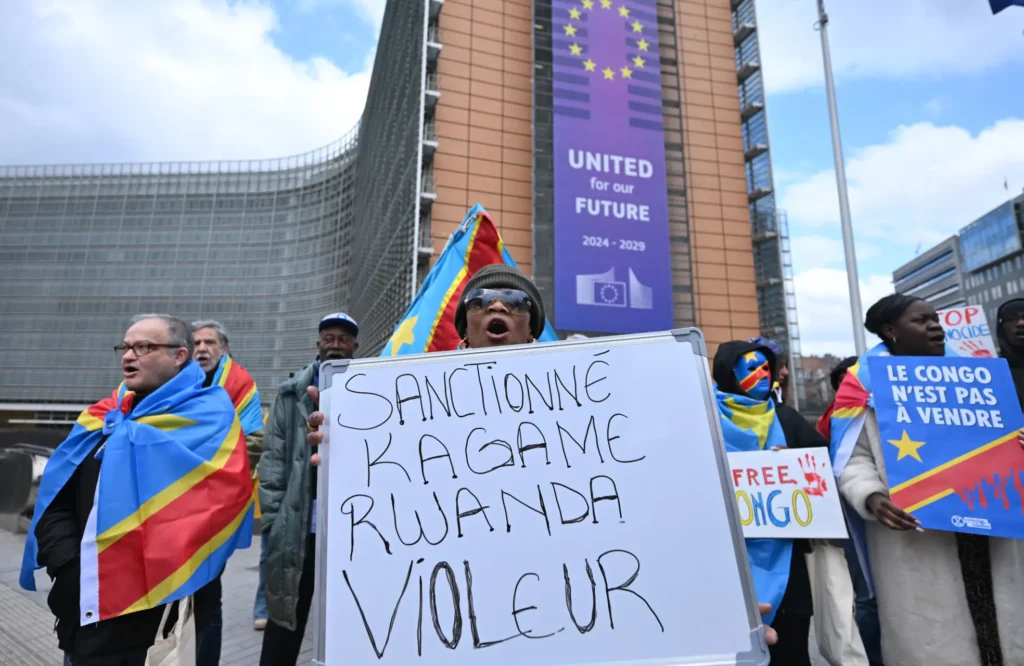
On March 2, 2026, the U.S. The Department of the Treasury’s Office of Foreign Assets Control (OFAC) formally designated the Rwanda Defence Force (RDF) and senior military officials under sanctions tied to instability in the Democratic Republic of Congo (DRC).
According to the U.S. Treasury press release, the designations were issued in response to what Washington described as RDF support to the M23 armed group operating in eastern DRC — including alleged provision of training, equipment, and operational assistance that enabled territorial seizures in mineral-rich areas.
This action was explicitly framed as enforcement tied to violations of the Washington Accords for Peace and Prosperity, signed in December 2025 to de-escalate conflict between Rwanda and the DRC.
At face value, this is a diplomatic enforcement measure. But structurally, it is something else entirely.
It is a geopolitical intervention into a mineral corridor that underpins global supply chains.
Sanctions That Touch the Mineral Economy
Eastern DRC is not peripheral terrain.
It contains globally significant deposits of:
- Gold
- Tin
- Tantalum
- Tungsten
- Coltan
- Strategic rare mineral systems
These materials feed directly into:
- Semiconductor manufacturing
- Semiconductor manufacturing
- EV battery components
- Defense electronics
- Aerospace systems
- Telecommunications hardware
According to the U.S. Treasury statement, RDF support allegedly contributed to M23’s ability to seize or hold key territories in North and South Kivu, areas long associated with mineral extraction and informal cross-border flows.
The implication embedded within the sanctions is clear:
Control over territory in eastern Congo is inseparable from control over mineral revenue streams.
And when that control is militarized, it becomes a financial risk event.
What OFAC Sanctions Actually Do — In Practice
The designation of the RDF and senior officials places them on the Specially Designated Nationals (SDN) list.
That means:
- Any assets under U.S. jurisdiction are blocked.
- U.S. persons are prohibited from transactions.
- Entities owned 50% or more by designated individuals may also be restricted.
- International banks with U.S. exposure must apply enhanced compliance measures.
In modern finance, this creates second-order effects. Sanctions are not just about asset freezes.
They are about risk contagion.
Banks de-risk relationships. Correspondent channels tighten. Compliance costs increase.
Trade finance slows.
For a country whose economic model relies heavily on external capital flows and export-driven credibility, this matters.
The RDF and Rwanda’s Economic Architecture
The reason these sanctions are economically significant is structural.
Unlike conventional military institutions, the RDF exists within a broader ecosystem that intersects with commercial entities and investment vehicles operating across construction, logistics, agro-processing, and infrastructure sectors.
Publicly documented investment structures linked historically to Rwanda’s political and security establishment include conglomerates involved in:
- Construction and engineering
- Agro-processing and export crops
- Energy projects
- Commodity exchange mechanisms
- ICT infrastructure
- Transport and logistics
The deeper question therefore becomes:
When a military institution is sanctioned in a system where political authority, security infrastructure, and economic assets are closely aligned, can the economic perimeter remain insulated?
Even if sanctions are technically targeted, global compliance behavior tends toward caution. And caution widens impact.
The Mining Supply Chain Implications
For mining stakeholders, the implications are not abstract. Eastern DRC and Rwanda are economically intertwined through:
- Cross-border mineral flows
- Refining and aggregation channels
- Regional trading networks
- Transit corridors
If sanctions heighten scrutiny around mineral traceability and territorial control, several consequences may follow:
Increased Due Diligence Costs
Downstream buyers — particularly in the EU and U.S. — may intensify compliance checks on supply chains linked to the Great Lakes region.
Reputational Risk Premiums
Minerals associated with contested areas may trade at discounted pricing or require additional certification.
Capital Allocation Shifts
Investors may redirect funding toward jurisdictions perceived as lower geopolitical risk.
Financing Constraints
Mining operators relying on Western banks may face more restrictive lending terms.
In commodity markets, perception drives pricing as much as supply and demand. Sanctions alter perception.
From Kinshasa’s point of view, the issue is not only military backing of M23. It is the economic architecture surrounding eastern Congo’s mineral wealth.
For more than a decade, successive United Nations Group of Experts reports have documented the movement of minerals — including gold, coltan (tantalum), tin and tungsten — out of eastern DRC through informal and illicit cross-border channels. These reports have consistently highlighted how armed group control over mining areas facilitates diversion of mineral flows away from Congolese state oversight.
Eastern Congo’s mineral belt is one of the most strategically important in the world:
- The DRC accounts for a significant share of global tantalum reserves.
- Eastern provinces host key tin and tungsten deposits.
- Artisanal gold production in Ituri and Kivu provinces is substantial but frequently under-declared.
When armed groups seize territory in North Kivu and South Kivu, they do not merely capture towns — they capture revenue points.
According to the U.S. Treasury’s March 2, 2026 statement, the Rwanda Defence Force provided material support that enabled M23 to seize and hold key territories, including areas of strategic economic value.
For the DRC, that language is significant.
Because territorial control in eastern Congo is directly linked to:
- Taxation of artisanal miners
- Control of trade routes
- Influence over mineral aggregation points
- Cross-border export channels
Kinshasa has long argued that once minerals cross into neighboring jurisdictions, they can be blended into formal export streams — making traceability difficult and distorting official export statistics.
This creates a structural imbalance:
Congo bears the security cost. Others benefit from export revenue.
The Role of Military-Linked Economic Structures
Rwanda’s economy includes powerful investment entities with historical links to the political and security establishment. These conglomerates operate across construction, logistics, energy, and commodity trading sectors.
From the Congolese perspective, the concern is not simply about battlefield support — it is about the intersection between military capability and commercial leverage.
When a military institution is capable of influencing territorial control in mineral zones, and when commercial entities operate in sectors connected to trade and logistics, the line between security activity and economic outcome becomes blurred.
The DRC’s longstanding allegation has been that mineral flows originating in conflict-affected areas are absorbed into formal regional trade systems, effectively transforming contested resources into legitimate exports.
While Rwanda officially rejects accusations of mineral exploitation and maintains that its exports are lawfully sourced, UN investigations over the years have repeatedly raised concerns about discrepancies between Rwanda’s reported mineral exports and its domestic production capacity.
This discrepancy is one of the reasons mineral traceability has become such a central international issue.
Why This Matters for Congo’s Economy
For the DRC, eastern mineral production is not marginal. It is tied to:
- State revenue
- Foreign exchange inflows
- Formalization of artisanal mining
- National development plans
- Investor confidence
When territory falls under rebel influence, several economic disruptions occur:
- Loss of Tax Revenue – The Congolese state cannot collect royalties or export duties.
- Shadow Pricing – Minerals may be sold below market value to informal buyers.
- Currency Leakage – Foreign exchange bypasses formal banking systems.
- Reputational Damage – International buyers become wary of sourcing from the region.
The result is not only insecurity. It is macroeconomic weakening.
For Kinshasa, U.S. sanctions against the RDF are therefore interpreted not just as punishment for military conduct — but as recognition that external support enabling territorial mineral capture has direct economic consequences.
The Structural Issue: Control of Congo’s Economy
At its core, the DRC perspective frames this crisis as one of economic sovereignty.
If external military backing helps an armed group hold mineral-rich territory, that effectively means:
- Control over extraction points
- Control over local trade networks
- Control over transit routes
- Influence over regional mineral markets
In fragile regions, economic control often precedes political control. And mineral corridors are not incidental — they are strategic.
The U.S. Treasury’s language linking RDF support to territorial and economic gains is therefore significant because it implicitly recognizes this economic dimension.
A Deeper Question for the Region
This moment forces a structural question:
Can peace in eastern Congo exist if mineral governance remains vulnerable to armed capture and cross-border economic distortion?
The DRC government has long argued that peace agreements must include not only ceasefires, but strict monitoring of mineral flows and external military disengagement.
Sanctions, in this context, become part of a larger enforcement architecture. They are not simply about punishment.
They are about:
- Deterring external military involvement
- Protecting mineral sovereignty
- Reinforcing traceability mechanisms
- Restoring investor confidence
For the Congolese population, particularly communities in North and South Kivu, the stakes are existential.
Mineral wealth should fund development, infrastructure, and public services. Instead, decades of conflict have diverted that wealth into insecurity.
From the DRC’s perspective, what happened on March 2, 2026 is not only a diplomatic action. It is an acknowledgment that:
The battlefield in eastern Congo is economic.
Territory equals minerals. Minerals equal revenue. Revenue equals power.
And when power is influenced externally, sovereignty is compromised.
The sanctions against the Rwanda Defence Force, as framed by U.S. authorities, mark one of the clearest international recognitions that control over eastern Congo’s mineral wealth is inseparable from regional security.
For Congo, this is not rhetoric.
It is about who controls its land, its resources, and ultimately, its economic future.
Washington’s Strategic Signal
The sanctions were not framed narrowly.
They were explicitly linked to the enforcement of a peace agreement signed just months earlier. That timing is deliberate.
Washington’s message is not only directed at Rwanda. It is directed at the region: Peace agreements tied to mineral governance will be enforced with financial tools. This reflects a broader evolution in U.S. foreign policy:
Sanctions are increasingly used not only for punishment, but for compliance shaping. Particularly in regions where security dynamics intersect with critical mineral access.
The Macro Risk Channels
If sanctions remain in place or escalate, several macroeconomic transmission channels emerge:
Sovereign Risk Perception
Ratings agencies and global investors incorporate sanctions exposure into sovereign risk assessments.
Currency Pressure
Reduced capital inflows or slower export settlement mechanisms can increase exchange rate volatility.
Cost of Capital
Borrowing costs may rise as lenders price geopolitical uncertainty.
Trade Friction
Heightened scrutiny at ports and banks may delay trade finance flows. None of these effects are immediate collapse scenarios.
They are friction multipliers.
And in smaller, externally dependent economies, friction compounds quickly.
The Regional Stability Variable
The Great Lakes region has long experienced cycles of armed group financing through mineral exploitation.
International efforts over the past decade have focused on:
- Conflict mineral certification systems
- Due diligence frameworks
- Cross-border monitoring
- Supply chain transparency
If military-linked actors are perceived to be facilitating renewed territorial mineral capture, it risks undermining those governance gains.
And if governance mechanisms weaken, investor confidence weakens with them.
This Is Bigger Than Rwanda
This episode illustrates a broader global pattern:
Critical minerals are no longer treated as neutral commodities. They are geopolitical assets.
Wherever military action intersects with resource control, financial enforcement tools now follow. For mining executives, institutional investors, and policymakers, the takeaway is structural: Security risk is now directly convertible into financial restriction.
Peace compliance is tied to capital access.
And mineral corridors are under geopolitical surveillance.
The sanctions imposed on the Rwanda Defence Force are not symbolic
.They sit at the intersection of:
- Peace agreement enforcement
- Mineral sovereignty
- Financial compliance systems
- Regional economic stability
Whether Rwanda recalibrates or absorbs the pressure is a political question. But the economic dimension is already in motion.
And for the mining sector, this is not a side story.
It is a reminder that in 2026, geopolitical risk and mineral economics are inseparable.
Discover more from Mining News Group
Subscribe to get the latest posts sent to your email.