
The highlights of his working visit to Lualaba on September 18 and 19, 2025 in detail.
Working together with the government to address the major challenges in the mining sector (artisanal and industrial), in accordance with the laws of the country and the vision of the President of the Republic and Head of State, Félix-Antoine Tshisekedi Tshilombo, and respecting constructive values, was the core message of Mr. Louis Watum Kabamba, the national Minister of Mines, during his working visit to Lualaba Province last week. It was within this framework that all relevant stakeholders attended this tripartite dialogue between the government, the FEC (Federation of Enterprises of Congo), and local communities, including civil society organizations in the mining sector.
Here are the highlights of this ministerial visit compiled by journalists from the FKF SOFTPRESS Group.
- Thursday, September 18
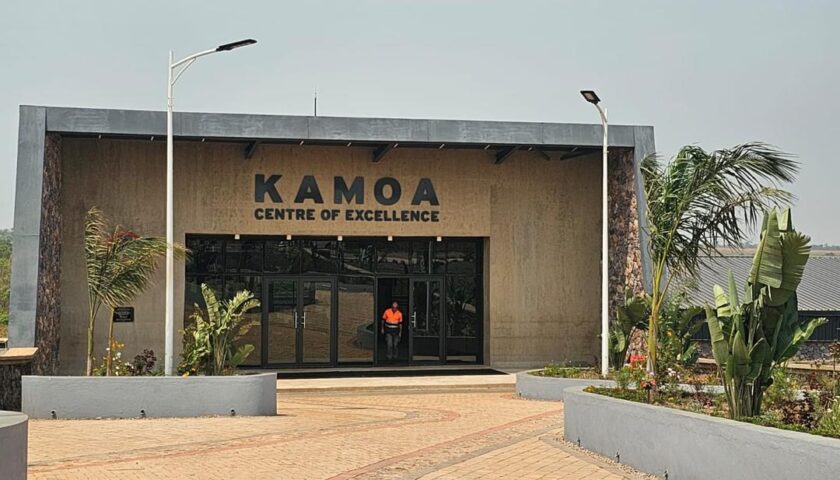
Upon arriving in Kolwezi from Kinshasa around 10 a.m., and warmly welcomed at Kolwezi airport by members of the provincial government and those of his cabinet who preceded him, including the Directors General or Deputy Directors General of Services and Establishments under the supervision of the Ministry of Mines, as well as the President of the FEC Lualaba and that of the Chamber of Mines accompanied by the captains of various mining companies in the country, Mr. Louis Watum Kabamba went directly to pay a courtesy visit to the head of the Province of Lualaba, Mrs. Governor Fifi Masuka as required by custom, before taking the road to the Center of Excellence of Kamoa Copper SA on site outside the city of Kolwezi for an important working session with the FEC, especially the Chamber of Mines.
- Message from the President of the Chamber of Mines
After the welcome address “to the house which he helped to build” by Ms. Anabel, the Managing Director of Kamoa SA, Mr. Kasongo Bon Nassor, President of the Chamber of Mines, hailed “an advocate for the sector and the spokesperson par excellence for miners” with whom the Chamber of Mines wishes to have a frank dialogue every quarter with the government to regularly exchange views on the business climate, respect for laws and the protection of investments “in the face of the regular changes in the rules of the game in the middle of the game”. - Message from the FEC
On behalf of the National President of the FEC, who was unable to attend, the President of the FEC Lualaba read the National President’s message, which emphasised the need for a sectoral and institutional consultation framework between mining companies and their employers in order to “build together a strategic platform” serving the country’s development. This framework for dialogue and consultation will address recurring issues related to the business climate and the ARSP’s (Regulatory Authority for Public Sector) oversight missions in mining companies.
The FEC advocated for internal controls to ensure compliance with the subcontracting law in order to facilitate ARSP audits. It also announced its desire to work with the government on concrete and definitive solutions, while inviting its members from the mining, telecommunications, and hydrocarbon sectors to a debriefing meeting on September 23, 2025, in Kinshasa, to discuss the discussions that took place during the recent audience granted to the President of the corporation by the President of the Republic and Head of State. - Message from the Minister of Mines
As the head of the sector, the Minister of Mines began by urging all stakeholders in the sector, primarily mining companies, government agencies, and local communities (including civil society), to exercise wisdom in all their actions. He reminded everyone that progress requires effort, and having taken note of the Chamber of Mines’ concerns regarding the Public Finance Law (LOFIP), he called on everyone to work together with public authorities to find sustainable solutions while respecting the laws of the country and national sovereignty.
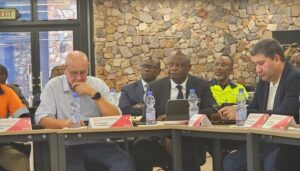
“This meeting must be a mass that leads to concrete things, not just another one of the many fruitless meetings that have taken place before,” the Minister of Mines told the miners, who also insisted on “strengthening good governance by fighting corruption and various bad practices in the mining sector, which is a source of hope for the country and its people.”
According to him, a tripartite structure is needed, including the State, mining companies and local communities, including civil society, “because of the capital structure of Mining which must produce taxes (for the State), dividends (for the mining shareholders) and sustainable development (for local communities).”
Faced with complaints about the encroachment of artisanal miners into mining areas with the complicity of certain state services, the Minister of Mines called on everyone: “corruption must not be stronger than the state” and asked everyone, including industrial miners, to “fight together to combat and eradicate corruption and bad practices in artisanal mining” throughout the country, including in the provinces of Lualaba and Haut-Katanga.
As a skilled and knowledgeable educator, combined with an experienced mining professional with over 35 years in the industry across different continents, Mr. Louis Watum reminded the audience of the two key allies for all investors who have chosen the Democratic Republic of Congo for their investments:
_ The laws and rules of the country that guarantee investments and protect assets;
– The public administration, including that of the Ministry of Mines.
Alerting his interlocutors in a firm and challenging tone about the poor perception of the country in the large community of major investors who meet regularly to evaluate mining jurisdictions around the world where to invest, the image of the DRC remains that of a Wild West and a War Zone; and Minister Watum insisted with patriotic fervor : “Government, mining companies and local communities with our civil society and our media, we must all fulfill our obligations to restore the image of our country as His Excellency the President of the Republic and Head of State keeps asking us to do”.
Publicly diagnosing the current state of the artisanal mining sector, he stated his lack of faith in its future unless mining legislation is amended to reflect the need for a transition from artisanal to small-scale mining. He then posed the question to everyone: “What will become of the 3 million artisanal miners who are in a sector I don’t believe in because it hasn’t generated capital or technology that would benefit everyone?”
With courage and candor, the Minister of Mines shared an observation that no one can dispute:
“This sector does not benefit the country and the population, and the results of artisanal mining to date are disappointing. Around the artisanal sites, we all observe a high rate of school dropout, early pregnancies, banditry, prostitution, environmental pollution and a Congolese workforce subjected to slave conditions whose real masters, who benefit from the rent of this activity, are foreigners but also members of the ruling political class in mining provinces.
Faced with this catastrophe, we have no choice but to effectively and promptly implement all the provisions of our existing laws that are in their favor (the artisans): in particular, to make viable artisanal operating zones (AEZs) available to them without delay, to establish them there, and to provide them with the necessary support so that their activities can be carried out under optimal conditions of hygiene and safety, without administrative hurdles. While we are working on this, we must also commit to investing in this human capital, whose average age ranges from 15 to 35, by gradually retraining them through vocational and technical training in promising trades that will allow them to earn a decent living and through which they will contribute to the reconstruction of our country. For among them, some have the potential to become business owners, and others can excel in various trades.
Regarding the ban on cobalt concentrate exports, the Minister insisted that it was “a responsible decision taken by the government, which is working on lifting it, but with accompanying measures for this strategic mineral in the name of national sovereignty, without giving in to pressure and lobbying from the Chinese or anyone else. The life of our country and our people is at stake.”
Regarding the levers of community development for communities directly affected by mining operations, Minister Watum emphasized “distributive justice and the sharing of prosperity based on equity in order to combat the islands of wealth and opulence that stand in stark contrast to the vast pockets of poverty. This must also be achieved through the Development Tax (DOT), the specifications of mining companies, and the Mining Royalties accruing to local authorities and provinces.”
Keen to contribute to community development and that of his sector, Mr. Louis Watum announced:
– The new generation specifications must align with long-term benefits and provide answers to a clear vision that we must formulate for any mining project: what do we want to leave to future generations when the deposit is exhausted?
– knowledge of the country’s geological heritage by involving Congolese geologists who will need to be provided with resources and supported by aerospace research and artificial intelligence;
– to encourage Congolese people to take stakes in projects developed by multinationals in the DRC, and to become shareholders;
– to develop a mindset among all stakeholders in the mining sector through the following values , which have contributed to the development of great countries throughout the world:
1. Patriotism: to love one’s country without betraying it, to love one’s neighbour without killing or poisoning him, to replace him or for one’s own interests in order to avoid and fight what the perpetrators of the tragedy in the East of our country are doing;
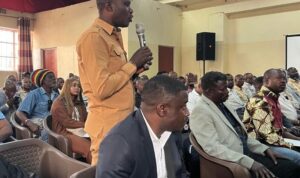
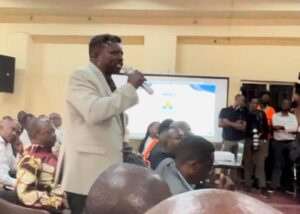
- Integrity: doing the right thing when people can’t see you and you’re alone;
- Pragmatism : obligation to achieve results beyond meetings and resolutions regardless of the precariousness of the means;
- Meritocracy : putting the right people in the right place without political or tribal patronage.
Before his closed-door meeting with industrial mining members of the Chamber of Mines, followed by a meal hosted by Kamoa Copper SA, Mr. Louis Watum emphasised the importance of sharing prosperity between businesses, local communities, and the country. The first day of the mission, also marked by the presence of Cyrille Mutombo, Country Director of Barrick Mining and CEO of Kibali Goldmine, the only industrial gold mining company operating in Haut-Uélé, concluded with a dinner hosted by VINMART Group at the Novotel Hotel in the evening. Meanwhile, the Minister of Mines, who was the guest of honor, continued his work, granting audiences to mining companies and members of the FEC (Federation of Congolese Enterprises) until the early hours of September 19, 2025.
- Friday, September 19, 2025
In his role as a tireless field man, the Minister of Mines’ workday led him early in the morning to Tenke Fungurume Mining accompanied by the Secretary General of Mines (Mr. Ramazani Lutuba), the Deputy Director General of Cami (Mr. Muyumba Ndubula), the Provincial Minister of Mines of Lualaba, the President of the Chamber of Mines (Kasongo Bin Nassor), the President of the FEC Lualaba (Germain Pungwe) and some members of his cabinet including his Deputy Chief of Staff (Mr. Marcellin).
As soon as he finished at TFM SA in Fungurume, the head of mines in the DRC, accompanied by all the heads of corps of the Ministry of Mines and members of his cabinet, the provincial Minister of Mines of Lualaba and the provincial officials of the services of the ministry of mines found themselves facing thousands of artisanal miners on the Mutoshi site, a PE of GECAMINES in lease with Chemaf but invaded for years for artisanal exploitation formerly supervised by the Comiakol cooperative which was assisted by the (American) NGO PACT CONGO.
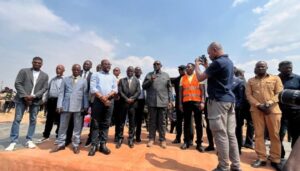
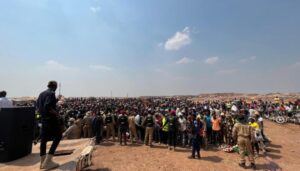
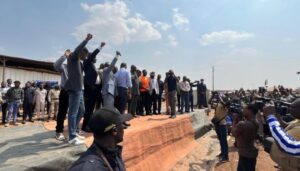
Warmly welcomed by the artisanal miners, under the coordination of the President of the Comiakol cooperative, Mr. Ngombe Sylvestre Petit-Petit, Minister Watum urged his guests to respect the country’s laws on artisanal mining, private property, and the rights of others, to fulfill their legal obligations, and to seek sustainable solutions to the problems facing artisanal mining with the support of relevant services, including those related to sustainable mining zones. This prompted a frank, constructive, and sincere exchange. The representatives of the artisanal miners and SAEMAPE requested that the attendees allow the Minister time to meet with members of the provincial mining cooperative union at SAEMAPE headquarters.
This was immediately done for at least two hours under the moderation of Sylvestre Ngombe Petit-Petit, after the presentation of SAEMAPE’s work by its CEO and its DP, during which eight major concerns were raised by the cooperatives present, disturbing and damning revelations made by Mr. Nyarkos, President of a mining cooperative on behalf of his peers present in the room, against the provincial politicians and their expatriate allies who have taken the artisanal mining sector hostage against the real cooperatives and manipulate people against all the authorities who come from Kinshasa to investigate or put order in the sector:
“You are the father of the artisanal miners who are obliged to protect you and work with you on solutions in their favor because they have known you since Kamoa and know that you have no vested interest in artisanal mining, even though you were once on the side of the industrial miners. Be the church in the middle of the village; do not sacrifice us for the interests of the industrial miners who came to us at various sites they obtained afterward in Kinshasa without informing us or relocating us as required by the mining code and regulations, from the 2002 version to the revised one of 2018. We refused to march against you last night, as some politicians asked us to do. We have nothing against you and we support you, even if they might come and harm us after you leave…”
After giving them ample time to express themselves and thanking them for “speaking sincerely from the heart in order to find solutions together” , Minister Watum responded to each of their concerns based on the creation of viable ZEAs and the overlap of industrial and artisanal mining operations (as referred to in Article 30, litera e of the Mining Code revised in 2018) by inviting them to more wisdom and patriotism, integrity, pragmatism and meritocracy by valuing the intelligence of many of them who do artisanal mining to survive.
“I am against artisanal mining as it is currently practiced. I want you to work with me to explore how to transition to small-scale mining for those whose calling is in artisanal work; and to retrain others through programs with the Ministry of Vocational Training so that you can become true entrepreneurs, employees in companies, and providers of solutions to the problems of the mining sector and the country. For the moment, the situation remains as it is, but in the short term, because together with you, industry leaders, and civil society, we must find sustainable solutions, as minerals are not renewable and deposits are being depleted. I told the industrialists the same thing, as they wasted $120 million (at KCC and TFM) building walls that don’t serve to block you today, when that money could have been used to do better in terms of sustainable solutions if everyone had engaged in dialogue. Let’s make a pact that you will all respect and uphold, to engage in dialogue, collaborate, and move forward together in the search for solutions while respecting the laws, without waging war which will serve no purpose. Do not serve the interests of foreigners who control your sector; work with your government on solutions so that you can control your sector and transition from artisanal mining to small-scale mining with the support of my ministry’s services.
It was with these words from Minister Watum, amidst a strong ovation from the delegates of the mining cooperative union, in the presence of all the heads of the bodies of the Ministry of Mines and the local press, that the meeting concluded in calm and peace in the early evening of September 19, 2025. The Minister of Mines then finished with a meeting with the Governor of Lualaba, the Honorable Fifi Masuka, and several audiences at his hotel until late.
Having completed its initial mission of listening, engaging, raising awareness, and conveying the Head of State’s message to the government regarding artisanal mining in Lualaba, the Ministry of Mines departed Kolwezi, along with its entire delegation, aboard an Air Katanga flight bound for Kinshasa at 9:30 a.m. local time on Saturday, September 20, 2025, to fulfill its other governmental duties. Meetings are scheduled in the near future with all stakeholders in the sector in Lualaba to find lasting solutions, as the time for endless speeches and meetings without progress or improvements on the ground is over.
By FKF SOFTPRESS.
Discover more from Mining News Group
Subscribe to get the latest posts sent to your email.